 Hongyue
1 / 3
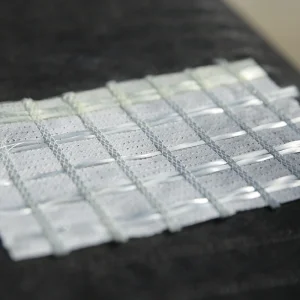
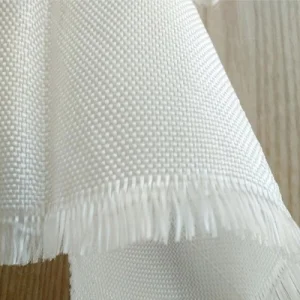
It has relatively high tensile strength and tear-resistance. It can maintain good strength and elongation properties whether in a dry or wet state. It can withstand relatively large tensile forces and external forces, effectively enhancing the tensile strength of the soil and improving the stability of the engineering structure.
It has excellent anti-aging performance and can resist the influence of external factors such as ultraviolet radiation, temperature changes, and chemical substance erosion for a long time. It has strong resistance to chemical corrosion such as acid and alkali, making it suitable for various soil and water environments.
There are certain gaps between the fibers, which gives it good water-permeability. It can allow water to pass through smoothly while effectively intercepting soil particles and fine sand to prevent soil erosion, forming a drainage channel inside the soil.
It has good resistance to microorganisms and insect damage, is not easily damaged, and can maintain stable performance in different and complex soil environments.
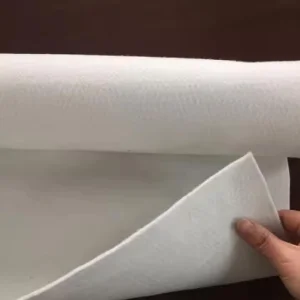
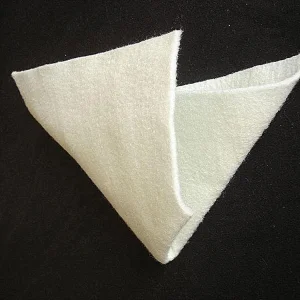
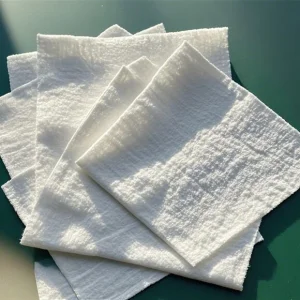
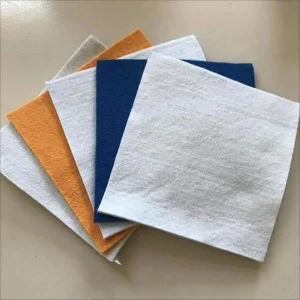
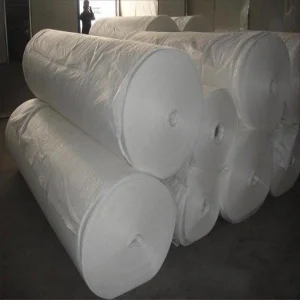
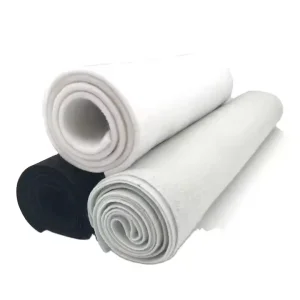
It is light and soft in material, convenient for cutting, carrying, and laying. It is not easy to deform during the construction process, has strong operability, improves construction efficiency, and reduces difficulty and cost.
Used for reinforcement of the subgrade of highways and railways. It improves the bearing capacity of the subgrade, reduces pavement cracks and deformation, and enhances stability. It is also used for road slope protection.
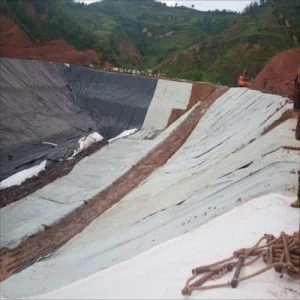
In hydraulic structures such as dams, sluices, and canals, it provides protection, anti-seepage, and drainage. It can be combined with a geomembrane to form a composite anti-seepage structure to prevent water leakage.
In landfills, it works for anti-seepage and isolation to prevent landfill leachate from polluting soil and groundwater. It is also used in mine tailings ponds to prevent environmental pollution.
Used for reinforcement treatment of building foundations to improve bearing capacity. In waterproofing projects such as basements and rooftops, it is used with other waterproof materials to enhance performance.
Applies to landscaping engineering, such as fixing plant roots and preventing soil erosion. It also plays a key role of anti-erosion and silt promotion in coastal tidal flats and reclamation projects.
| Parameter | Description |
|---|---|
| Material | Polyester fiber |
| Thickness (mm) | [Specific value, e.g. 2.0, 3.0, etc.] |
| Unit Weight (g/m²) | [Corresponding weight value, like 150, 200, etc.] |
| Tensile Strength (kN/m) (Longitudinal) | [Value indicating longitudinal tensile strength, e.g. 10, 15, etc.] |
| Tensile Strength (kN/m) (Transverse) | [Value showing transverse tensile strength, e.g. 8, 12, etc.] |
| Elongation at Break (%) (Longitudinal) | [Percentage value of longitudinal elongation at break, for example 20, 30, etc.] |
| Elongation at Break (%) (Transverse) | [Percentage value of transverse elongation at break, such as 15, 25, etc.] |
| Water Permeability (cm/s) | [Value representing water permeability speed, e.g. 0.1, 0.2, etc.] |
| Puncture Resistance (N) | [Value of puncture resistance force, like 300, 400, etc.] |
| UV Resistance | [Description of its performance in resisting ultraviolet rays, such as excellent, good, etc.] |
| Chemical Resistance | [Indication of its resistance ability to different chemicals, e.g. resistant to acid and alkali within certain ranges] |