Geotextile Coir is gaining attention as infrastructure planners seek lower-impact erosion-control materials. It is made from coconut husks, then formed into mats, logs, blankets, or woven meshes. These products can protect exposed soil on riverbanks, slopes, drainage channels, and coastal landscapes.
The market context is encouraging, but not simple. Grand View Research’s geotextiles market analysis reports sustained global growth, driven by road construction, drainage systems, and environmental restoration. The International Geosynthetics Society also emphasizes performance-based selection, including tensile strength, filtration, permeability, and installation conditions. Coir adds a biological advantage. It can support vegetation while gradually decomposing. Yet durability varies sharply with fiber quality, weave density, moisture, and ultraviolet exposure.
Field details matter.
A supplier may advertise “natural” performance, but buyers still need test certificates, batch traceability, and installation guidance. ASTM and ISO methods can help compare strength, mass, water flow, and biodegradation. A ranking can still mislead. The strongest product is not always the best product for a steep wet slope or a short-term restoration site.
As geosynthetics pioneer Professor J. P. Giroud stated, “There is no substitute for good engineering.” That principle guides this list of the Top 10 Geotextile Coir Manufacturers for Global Buyers. The selection considers technical consistency, manufacturing capacity, export readiness, documentation, customization, and after-sales support. It also recognizes an uncomfortable truth: public product data remain uneven across this industry. Buyers should verify claims directly, request samples, and assess performance against local soil, rainfall, and project specifications.
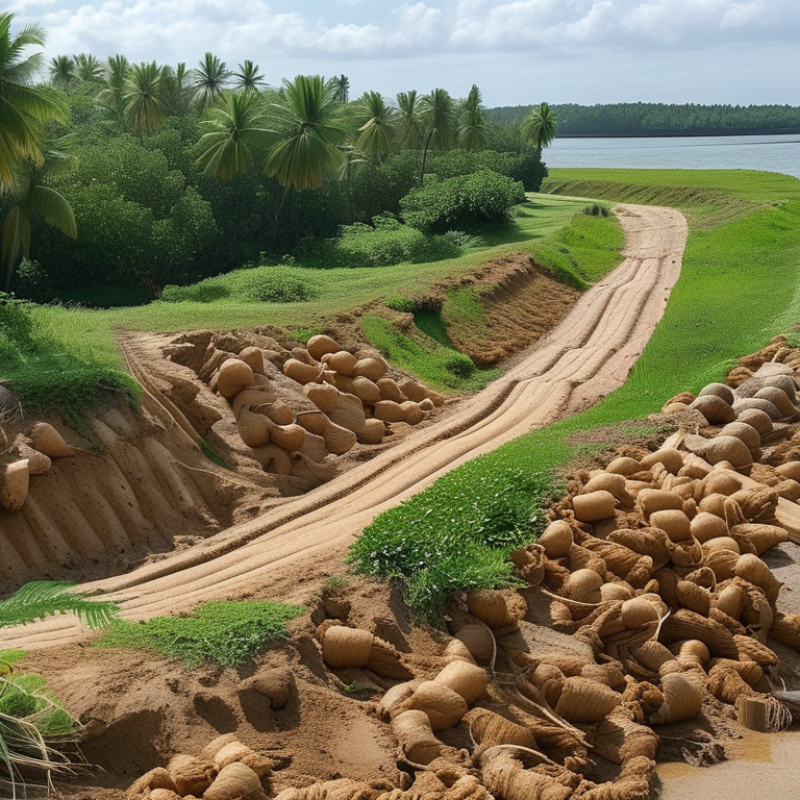
Geotextile coir products are erosion-control materials made from coconut husk fibers. They commonly include woven coir mats, coir blankets, logs, and mesh rolls. Their coarse surface slows rainfall runoff and helps soil hold grass or other vegetation seeds. Water can pass through the open fibers while soil particles remain more stable.
These products are used on road embankments, drainage channels, riverbanks, construction slopes, and newly restored landscapes. A coir blanket can reduce surface erosion while plants establish roots. Coir logs are often placed along shallow waterways to soften bank edges and trap sediment. The material gradually biodegrades, leaving behind a stronger root network. It is not permanent armor. This matters.
Installation quality strongly affects performance. The surface should be graded, seeded, and pinned securely against the soil. Loose edges can lift during heavy rain. Uneven contact may create channels beneath the mat. Field teams should check fiber density, roll dimensions, moisture condition, and breaking strength before installation. Reliable suppliers can provide test records and clear application guidance.
Coir is renewable and naturally biodegradable, but it is not suitable for every site. Constant flooding, strong wave action, or long project lifespans may require additional engineering. Fiber quality can also vary between production batches. A practical specification should account for local rainfall, slope angle, soil type, and expected vegetation growth. Small details matter.
Choosing among the top 10 geotextile coir manufacturers requires more than comparing prices. Global buyers should examine production experience, raw material control, and technical support. A dependable manufacturer can explain coir fiber grades, weave density, roll dimensions, and expected service life. Ask for recent test reports covering tensile strength, mass per unit area, water permeability, and biodegradation behavior. Vague answers deserve caution.
Request physical samples before placing a large order. Inspect stitching, edge stability, fiber uniformity, and moisture condition. A small sample can reveal uneven weaving or weak packaging. Verify whether the factory controls processing internally or relies heavily on unknown suppliers. Factory photographs help, but an independent audit provides stronger evidence. It is not perfect, though. Even experienced buyers can overlook seasonal changes in fiber quality.
Tips: Compare at least three manufacturers using the same specification sheet. Check certifications, laboratory names, batch traceability, and export documentation. Confirm production capacity during peak seasons, not only in quiet months. Discuss container loading, moisture protection, labeling, and replacement procedures in writing. Reliable suppliers explain limitations clearly and provide realistic delivery dates. Sustainable claims should also be measurable, supported by sourcing records and end-of-life information. Ask practical questions. Silence is information.
Top geotextile coir manufacturers distinguish themselves through dependable fiber selection, disciplined processing, and practical field performance. They produce coir mats, erosion-control blankets, coir logs, and woven rolls for slopes, riverbanks, drainage channels, and wetland restoration. Experienced manufacturers grade coconut fibers by length, strength, moisture, and contamination before weaving. That step matters. It reduces weak spots during installation and supports more even soil coverage.
Their strongest advantage is often customization rather than a single standard product. They can adjust mesh openings, roll dimensions, density, stitching, and biodegradation periods for different site conditions. For steep embankments, tighter meshes and reinforced edges may improve handling. For early vegetation, open meshes can leave space for seeds and roots. Reliable suppliers also provide installation guidance, sample testing, batch records, and clear load or service-life data. These details help engineers compare products beyond attractive catalog photos.
In buyer evaluations, I would inspect tensile strength, water flow, fiber consistency, packaging, and delivery control. Independent test reports add credibility, but they should match the actual production batch. No manufacturer is perfect. Some products may vary in thickness, smell, or edge stability after storage. That weakness deserves attention, especially in humid warehouses or long-distance shipping. I would still request a small trial section before approving a large order.
Global buyers should assess coir geotextiles through measurable quality, not attractive claims. EN ISO 10319 testing verifies tensile strength, while EN ISO 12957 evaluates water permeability. Request batch-level results, mass per unit area, stitch spacing, and dimensional tolerance. A product that looks dense may still fail under wet soil and repeated rainfall.
Certification supports trust, but it does not replace technical evidence. ISO 9001 indicates controlled production, while ISO 14001 supports environmental management. For sustainability, demand traceable coconut fibers, chemical-use records, and documented worker protections. The Textile Exchange Materials Market Report 2024 estimates global fiber production reached 124 million tonnes in 2023, increasing pressure on lower-impact materials. Coir can reduce synthetic content, yet biodegradation speed depends on moisture, temperature, soil biology, and treatment.
The OECD Global Plastics Outlook reported 460 million tonnes of plastic production in 2019, with only 9% recycled. That context makes natural erosion-control materials relevant. Still, “biodegradable” needs conditions and a timeframe. Ask for laboratory biodegradation data, not only marketing language. I would also inspect storage: poorly protected rolls can absorb moisture, grow mold, or lose strength before installation. That detail is often missed. Third-party testing remains preferable, although even certified suppliers deserve periodic audits and field sampling.
Choosing among the top 10 geotextile coir manufacturers requires more than comparing prices. Your project conditions should guide the shortlist. A steep riverbank needs stronger erosion control than a flat garden slope. Coastal sites also require careful attention to salt exposure, rainfall, and installation timing.
Request a complete technical datasheet. Check mass per square metre, tensile strength, thickness, aperture size, and water permeability. Ask for test methods, not only attractive performance numbers. A dependable supplier can provide recent batch records, product samples, and traceable raw-material information. Independent laboratory results are useful, but they should match the material you will actually receive. Do not rely on one sample.
Market experience matters too. Ask whether the manufacturer has served similar climates and project sizes. Review packaging, moisture protection, loading methods, and realistic production capacity. Confirm lead times in writing. Small delays can leave exposed soil vulnerable after heavy rain. Clear export documents and responsive communication reduce avoidable problems.
I once focused too heavily on unit cost and overlooked inconsistent roll density. The cheaper shipment created extra cutting and installation work. That mistake changed my supplier checklist. I now request a pre-shipment inspection, installation guidance, and a written response plan for damaged goods. A strong supplier should discuss limitations honestly, including storage life and biodegradation timing. Some buyers want faster coverage, while others need longer field performance. The right choice depends on soil, weather, contractors, and local market expectations.
| Profile | Typical Manufacturing Region | Main Product Form | Common Mass Range | Typical Mesh Opening | Nominal Service Period | Typical Roll Width | Relevant Test Standards | Customization Capability | Typical Export Readiness | Best-Fit Applications | Key Buyer Verification |
|---|---|---|---|---|---|---|---|---|---|---|---|
| Supplier Profile 01 | South Asia | Woven coir matOpen-weave netting | 400–900 g/m² | 10–25 mm | 24–36 months | 2.0–4.0 m | EN ISO 10319; EN ISO 9863-1 | ★★★★★ | High | Steep slopes, riverbanks, drainage channels | ✓ Confirm tensile strength in both directions and roll-length tolerance. |
| Supplier Profile 02 | South Asia | Lightweight erosion blanketBiodegradable mat | 300–500 g/m² | 15–25 mm | 12–24 months | 2.0–3.0 m | ASTM D4355; EN ISO 12956 | ★★★★☆ | High | Grass establishment, roadside landscaping, mild slopes | ✓ Request UV-exposure data and biodegradation-period evidence. |
| Supplier Profile 03 | South Asia | Heavy-duty woven matHigh-strength geotextile | 900–1,200 g/m² | 10–20 mm | 36–60 months | 2.0–4.0 m | EN ISO 10319; ASTM D4595 | ★★★★★ | Medium to high | High-flow channels, embankments, coastal protection | ✓ Verify wet tensile strength, seam performance, and hydraulic requirements. |
| Supplier Profile 04 | South Asia | Machine-stitched blanketSeeded erosion mat | 500–900 g/m² | 15–30 mm | 24–36 months | 2.0–3.0 m | EN ISO 10319; EN ISO 9863-1 | ★★★★☆ | Medium | Revegetation projects and green infrastructure | ✓ Check stitch spacing, seed compatibility, and installation instructions. |
| Supplier Profile 05 | Southeast Asia | Coir fiber meshSlope-stabilization roll | 700–1,000 g/m² | 20–40 mm | 24–48 months | 2.0–4.0 m | ASTM D4751; ASTM D4595 | ★★★★☆ | Medium to high | Large-area slopes, construction-site rehabilitation | ✓ Compare aperture size with soil gradation and expected runoff velocity. |
| Supplier Profile 06 | South Asia | Fine coir nettingLandscape mat | 250–450 g/m² | 10–20 mm | 12–24 months | 1.0–2.0 m | EN ISO 9863-1; ASTM D5199 | ★★★☆☆ | High | Gardens, nurseries, small drainage and landscaping works | ✓ Confirm edge stability, moisture resistance, and minimum order quantity. |
| Supplier Profile 07 | Southeast Asia | Needle-punched coir blanketComposite erosion mat | 800–1,500 g/m² | 10–30 mm | 36–60 months | 2.0–4.0 m | EN ISO 10319; ASTM D4355 | ★★★★☆ | Medium | High-rainfall regions and long-duration vegetation projects | ✓ Ask for thickness uniformity, water-flow data, and accelerated-aging results. |
| Supplier Profile 08 | South Asia | Coir log and mat systemBank-protection product | 600–1,200 g/m² for mats | 20–40 mm for mats | 24–48 months | 1.0–3.0 m | ASTM D4595; EN ISO 10319 | ★★★★☆ | Medium to high | Streambanks, wetlands, pond edges, habitat restoration | ✓ Confirm buoyancy, anchoring accessories, and installation details for water environments. |
| Supplier Profile 09 | Southeast Asia | Wide-format coir blanketProject-specific mesh | 700–1,000 g/m² | 15–30 mm | 24–36 months | 3.0–5.0 m | EN ISO 10319; EN ISO 9863-1 | ★★★★★ | Medium | Major infrastructure corridors and large revegetation areas | ✓ Review container loading plan, roll handling, and project-level production capacity. |
| Supplier Profile 10 | South Asia | Retail-ready erosion blanketSmall-roll format | 350–700 g/m² | 10–25 mm | 12–36 months | 1.0–2.0 m | ASTM D4355; EN ISO 9863-1 | ★★★★☆ | High | Distributor networks, landscaping contractors, small projects | ✓ Check packaging durability, barcode options, private-label restrictions, and carton dimensions. |
: They are erosion-control materials made from coconut husk fibers. Common forms include mats, blankets, logs, and mesh rolls. Their rough surfaces slow runoff and help seeds remain in place. Water passes through. Soil stays more stable.
They are used on road embankments, drainage channels, riverbanks, and construction slopes. They also support newly restored landscapes. Coir blankets protect exposed soil while vegetation develops roots. The right product depends on local conditions.
The fibers reduce rainfall speed across the soil surface. They help prevent soil particles from washing downhill. Seeds can remain beneath the blanket until roots develop. The blanket is temporary protection, not permanent armor.
Coir logs are placed along shallow water edges. They soften bank surfaces and help trap moving sediment. Their fibers can support early plant growth. Strong waves may exceed their practical limits.
The soil should be graded, seeded, and covered evenly. Teams should pin the material firmly against the ground. Loose edges may lift during heavy rain. Gaps can create hidden channels beneath the mat. Small mistakes matter.
Request tensile strength, water permeability, mass per unit area, and stitch spacing. Roll dimensions and dimensional tolerance should also be recorded. Batch-level test results are more useful than attractive photographs. A dense-looking mat may still weaken when wet.
Coir uses a renewable fiber from coconut husks. It naturally biodegrades under suitable moisture, temperature, and soil conditions. The breakdown speed is not always predictable. Ask for laboratory data and fiber traceability. “Biodegradable” needs a timeframe.
Check fiber density, moisture condition, breaking strength, and roll dimensions. Store rolls in a dry, protected area. Poor storage can cause moisture absorption, mold, or early strength loss. Production batches may vary. I would inspect samples, even from trusted suppliers.
This guide introduces Geotextile Coir products, made from natural coconut fibers and designed for erosion control, soil stabilization, drainage support, slope protection, and landscape restoration. It explains how these biodegradable materials perform in different environments and why they are increasingly considered for projects that balance engineering performance with environmental responsibility. Buyers will also learn how to assess manufacturers through production capacity, raw material consistency, technical support, export experience, and the ability to provide customized specifications.
The article compares leading types of Geotextile Coir manufacturers by product strengths, including woven and nonwoven coir mats, erosion-control blankets, coir logs, and related solutions. It also highlights important quality, certification, traceability, and sustainability considerations, such as fiber durability, dimensional stability, responsible sourcing, and compliance with project requirements. Finally, the guide offers a practical framework for selecting the right supplier according to climate, application, service life, budget, delivery needs, and target-market standards.

Hongyue